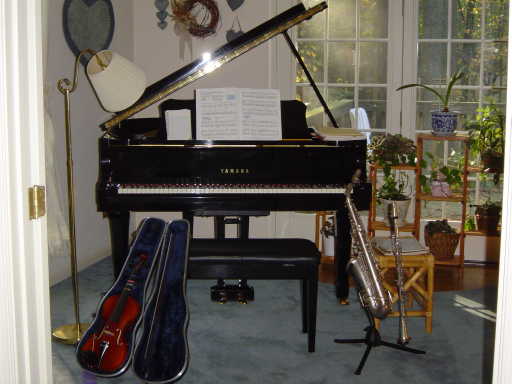
Violin and saxophone not
included |
the
Anatomy
of a Piano
How the
inside of a piano really works! |
You play a note. You get a sound.
Simple, right?
Not quite.
The piano was invented over 300
years ago, and while many inventions are improved upon
over time, the piano managed to do something that
hasn't been equaled by a keyboard instrument before or
since. It is capable of responding to almost limitless
varieties of human touch, producing sounds ranging in
volume from thunder to a whisper and as many shades of
sound as a gifted painter could produce on a canvas.
Neither the instruments that preceded it (organ,
harpsichord, clavichord, etc.) nor the modern day
electronic keyboard which has replaced it in some
places respond to the subtle imaginations of the
player like the piano. It is not, however, such a
simple matter to bring such a device into being.
When you depress a piano key,
several things happen.
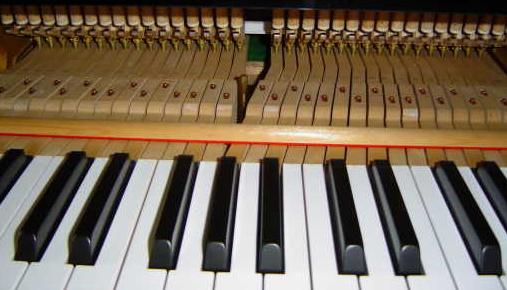 |
For starters,
each key is actually about two feet long, most
of which is hidden in the interior of the piano.
While the front of the key is being pressed
downward, the back of the key "lever" is
ascending. But far from being like a see-saw,
the rear of the key lever instead activates a
spring that tosses the hammer at the string
independently from the key itself. This is
important. If the two parts weren't independent,
the string wouldn't be able to vibrate freely
when struck. |
Try pushing a key down slowly. At
about 2/3 of the way down you should feel a "bump"
when the hammer is suddenly released at the string. If
you depressed the key slowly enough you won't hear a
sound because the hammer didn't have enough force to
reach the string and cause it to vibrate. But the
hammer was still tossed at the string, even if it
didn't have enough energy to actually get there.
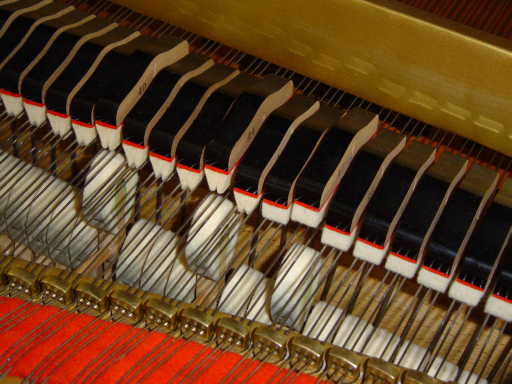
Here keys have just
been struck. After striking the strings, the
hammers have fallen about halfway down to their
original position, poised to re-strike the
string if the player retakes the key. They won't
fall all the way down until the player releases
the key entirely. This allows for quick
repetition of notes since the hammers only have
to travel half the distance in case of a key
being re-struck. The dampers are still raised,
allowing the string to keep vibrating until the
player lets go of the key. |
Piano hammers
have to be able to do three things. Obviously,
when the key is depressed, they need to make
contact with the string so that the note sounds.
But if that were all that were necessary, a
simple see-saw contraption would do nicely. It
isn't.
One of the piano's
ancestors, the clavichord, had such a simple
action. The problem is that in order to allow
the string to keep vibrating the hammer must
"let go" of the string. If it remains in
contact, the sound that it created will be
squelched. So in addition to hitting the
strings, the hammer must fall back down and
let the string it struck go on vibrating
unhindered.
On the other hand, you can't
have a hammer just bouncing around. If you
struck a note with a lot of energy, it might
come back up and strike the string a second
time for each note you played. Two-for-one
deals are not always desirable, which is why
behind the hammers are felt "back-checks" to
catch the hammer once it has fallen back off
the string (the light brown items below).
|
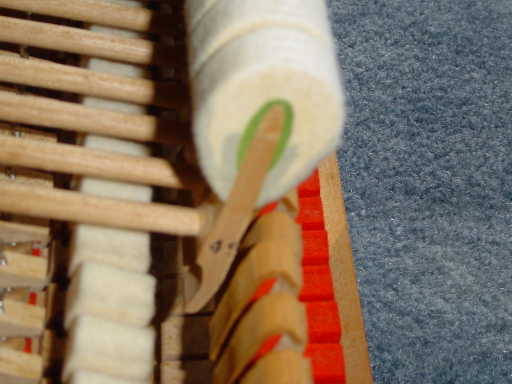
| The hammers are
made of felt. Like many of the piano's parts, a
number of materials were tried out during the
150 years between its first appearance (around
1700) and the last real innovations (1840s).
Eventually, the hammers get hard and brittle and
need to be shaved or they will break strings. |
 |
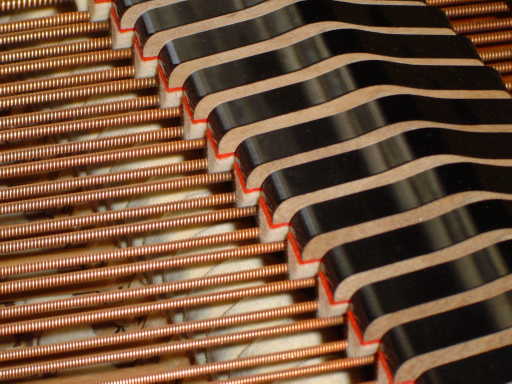
Dampers are cushions of felt
which rest lightly on the strings for nearly the
length of the piano (except the highest notes, which
are considered too weak to need them). If you
try to pluck a string while the dampers are at
rest, you'll hear that the sound doesn't last
very long. The string is being stopped from vibrating
and is not going to make much sound. When you depress
a key, the back end of the key lever is raised;
besides tossing the hammer at the string the key is
also connected (in a much simpler manner) to a rod
connected to the damper and thus raises the damper off
the string, allowing the string to vibrate on its own
for as long as the key is held down.
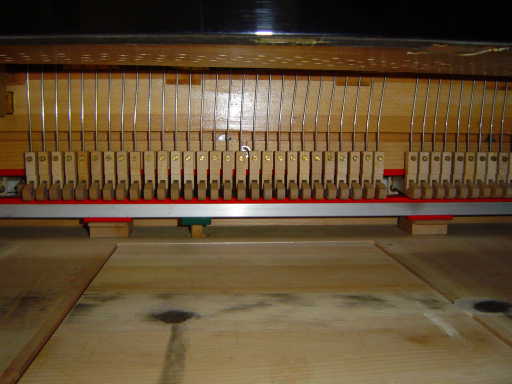 |
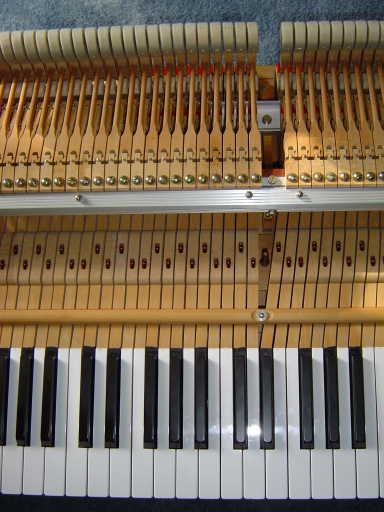
With the keys and
hammers taken out of the piano, you can see the
thin metal rods that raise the dampers off the
strings rising up from where the back of the
key-lever would push them upward to the dampers
above the strings, which of course you can't see
from this angle (but trust me, they're up there
somewhere). |
| Another way to
raise the dampers is to depress the sustaining
pedal. That would be the one on the right,
regardless of whether your piano has three or
two pedals. This foot-operated lever, sometimes
mistaken for a gas pedal (and used similarly)
was once operated with the knee (in Mozart's
time). When you depress the pedal, all the
dampers are raised at once throughout the piano.
This allows every note you play to continue to
sound for as long as the strings will vibrate or
until you release the gas--er, sustaining pedal.
|
 |
Two more pedals adorn most grand
pianos. The one on the left is often referred to as
the "soft" pedal. Its technical name is una corda,
or one string, since, when deployed, it causes
the entire action to shift slightly so that the
hammers in the upper part of the piano, where there
are three strings to a note, only strike one string.
The effect of this is to make the piano softer, but it
also changes the sound rather significantly. For this
reason, many concert pianists maintain that using it
in soft passages is really cheating. But as Leon
Fleischer puts it, "There are many people who believe
soft passages should be played without the use of the
una corda pedal, and I go to them for
confession every Sunday!"
The middle pedal, where one exists,
is called the sostenuto pedal. It is a rather
strange device which causes the dampers which are
already off the strings to stay that way when you let
go of the keys. In order to get it to work, you must
first play a chord, and while you are holding it down,
depress the pedal. Now those notes, and only those
notes, will be sustained just like they would be if
you had used the sustaining pedal. But any notes you
play after the pedal is down will not be sustained.
This pedal requires a good sense of timing, and, since
most of our great composers didn't have one on their
pianos, very little music actually makes use of that
pedal, though I've occasionally found it useful for
certain effects. All in all, however, it is the
closest thing to the piano's appendix. If your sostenuto
pedal becomes inflamed, I highly recommend taking it
out!
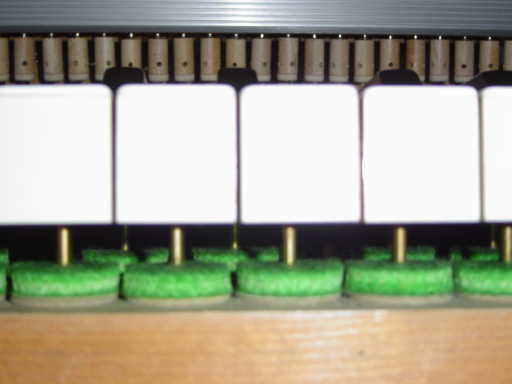 |
The green
cushions below the keys are designed to give the
keys something soft to land on when struck from
above. They are just one of an amazing number of
parts which should all be uniform throughout the
piano's range. In this case the idea is to make
each key travel the same distance to the bottom
with each stroke so the player feels a
consistency in the effort required to depress
each key. I remember spending several hours in a
piano maintenance workshop putting additional
little paper donuts on top of the worn-out
bushings so that the key depth would be equal.
Let me add that there are also an insane number
of screws throughout a piano's action that need
to be adjusted as well! (This kind of operation
is called "regulating" and is thankfully not
done to a piano very often) |
 |
Pins and Pin
block
Near the front of the
piano, the strings are fastened to tuning pins
which can be rotated to increase or decrease
tension on the strings, thus raising or
lowering their pitch.
Under the metal covering you
see here is a dense, wooden block into which
the pins are tightly driven. But not so
tightly that a guy with a tuning hammer (looks
a lot like a socket wrench) can't adjust the
pin's position. A slight twist clockwise is
enough to raise the pitch of the string. But
it must be done carefully so the pin will stay
in that position and not settle back into its
old habit when the tuner leaves!
|
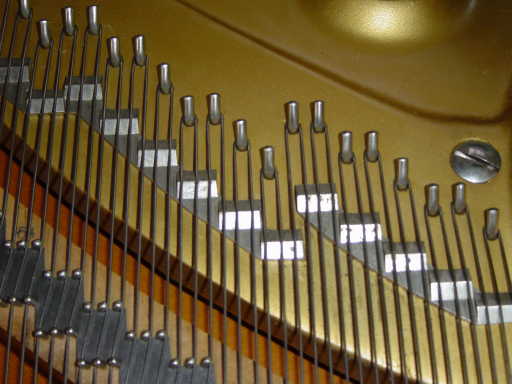
| Hitch Pins
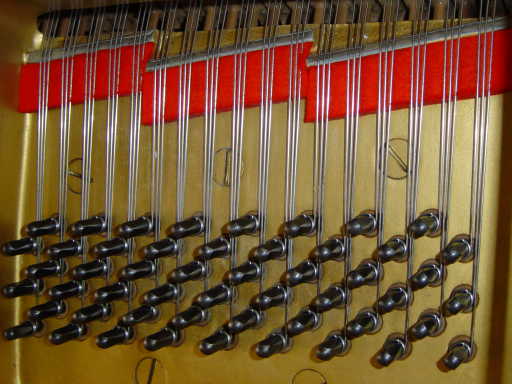
At the other end, the
strings are looped around "hitch pins" or end
pins. Then the string is sent back to
the next tuning pin at the front of the piano.
What appears to be two different strings is
actually two halves of the same string. These
two halves may be used for different notes.
The string is wrapped around the hitch pin
tightly enough that this is possible.
Adjusting one half of the string does not
affect the other half.
|
|
 |
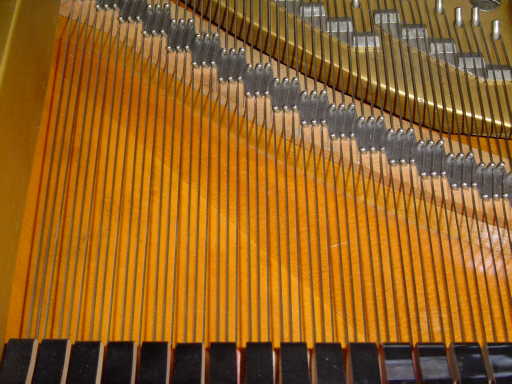
The bass strings
are thick and coiled for more power. At the low
end of the piano one string serves for each note
and is not wrapped around hitch pins. After the
first octave, a thinner string is deployed and
two of them are used for each note. For most of
the piano, however, the strings are thin and are
deployed in sets of three to a note (that is,
three string halves)
I know a tuner who broke a
bass string once while tuning. The long end
shot out of the piano and smashed a plate
glass window! Not only do these things growl,
they can be dangerous when aroused!
|
 |
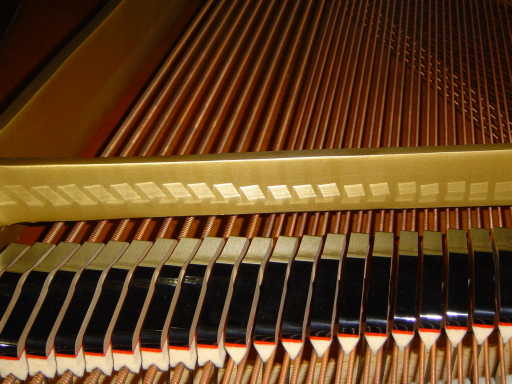
The agraffes are
metal bridges with little holes for the piano
strings to slide through. Their purpose is to
guide the strings precisely into position above
the hammers. If they are off by even a little,
you will not hear the note you thought you
played. Worse, you could hear parts of two of
them. |
 |
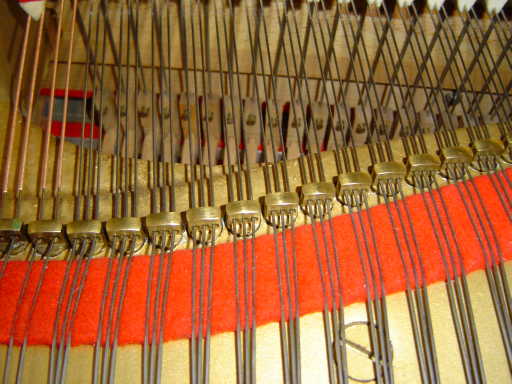
On the other end,
graphite bridges with tiny pins on each end
guide the strings into position for their ride
around the hitch pins. Between the agraffes and
the graphite bridges is what is known as the
string's "speaking length". The strings do not
vibrate beyond those points. Sometimes felt is
inserted to the strings on these ends to give
additional help in muting the strings. If they
vibrated along their entire length, the tuning
pins and hitch pins would share in the
vibration. It is not particularly beneficial to
have that many metal parts vibrating
unnecessarily! |
|
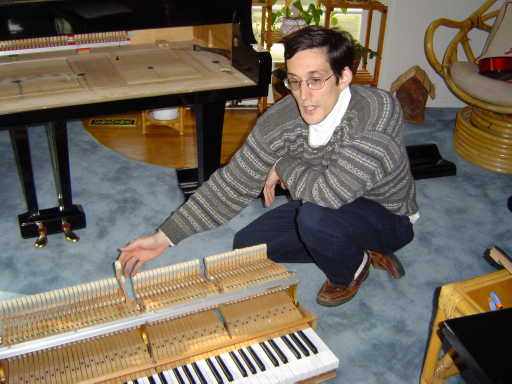
This is the
entire "action" of the piano removed. You can
see how the hammers have their own rail above
the key levers. When the key is depressed, the
back of the key lever strikes the back of the
hammer apparatus, and the hammer is tossed at
the string at the same rate of speed as the key
was pushed down to begin with. This allowed the
instrument to be played loudly or softly
depending on the player's actions. It was the
first keyboard instrument that allowed this, and
was thus named the Pianoforte, which is a
collision of the Italian words for soft (piano)
and loud (forte). |
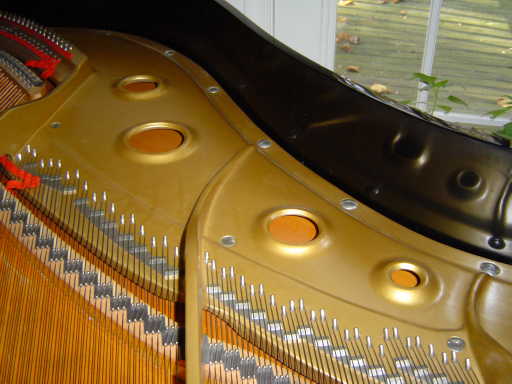
| If
anybody has any ideas about what those craters
are for, let me know. |
 |
much thanks to Rosanne Ruffo for
allowing me to take apart her piano and for her
excellent photography.
|